After the alert

One alert. One operational case.

Signal Core starts when your monitoring raises an alert. It is not a monitoring or data-acquisition platform. It turns the alert into a case your team can follow from acknowledgement to an explainable decision.

  1. Notify & acknowledge
  2. Respond to plan
  3. Inspect in the field
  4. Investigate
  5. Decide & resolve

Signal & Timeline

The complete operational story.

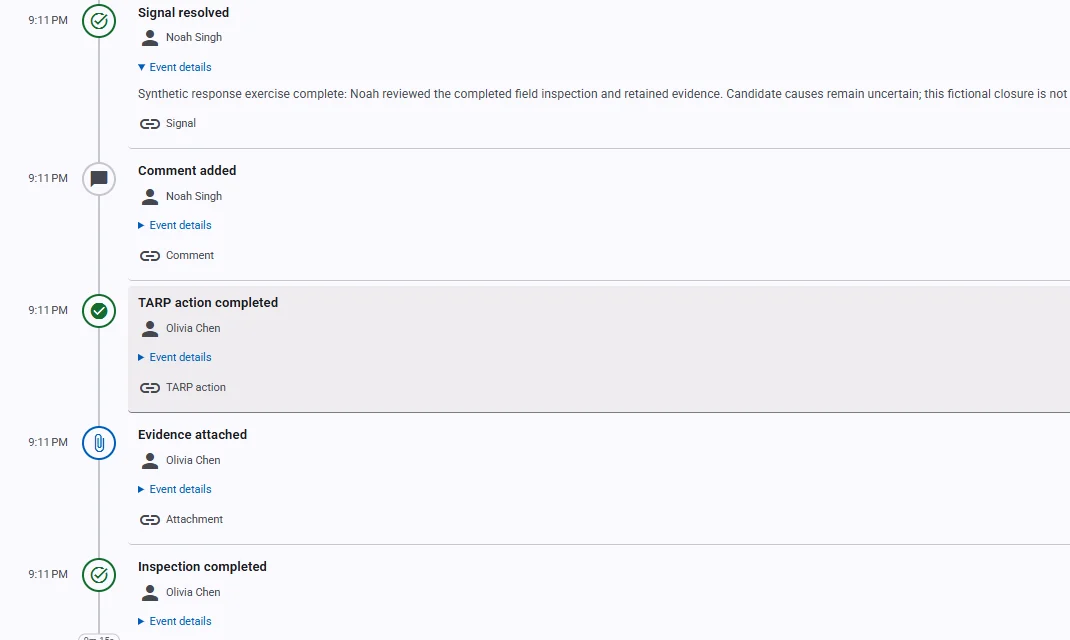
The Signal Timeline is the durable history of the operational case: what happened, who responded, what was done, what evidence existed, and why the issue was resolved.

Important events remain understandable as the Signal moves through response, investigation, escalation, resolution, and, when circumstances change, reopening.

  • The alert and its source
  • Notification, acknowledgement, and ownership
  • TARP actions, deadlines, and field work
  • Evidence, investigation, and decisions
  • Escalation and accountable completion
  • Resolution and reopening
Signal Core Timeline listing inspection completed, evidence attached, TARP action completed, comment added and Signal resolved
Who did what, when, and on what evidence: your answer when someone asks why.

01 · Notify & acknowledge

Make delays visible before they become the process.

The right people are notified when an alert arrives. Acknowledgement and ownership are recorded with the case.

When no one responds in time, the Signal escalates according to responsibilities agreed for the operation.

01

Reach the responsible team

Notifications follow the teams responsible for the response.

02

Record acknowledgement

Who acknowledged, when, and with what note.

03

Escalate when no one responds

Overdue acknowledgement or follow-up becomes visible.
02 · Respond to plan

Turn the response plan into visible work.

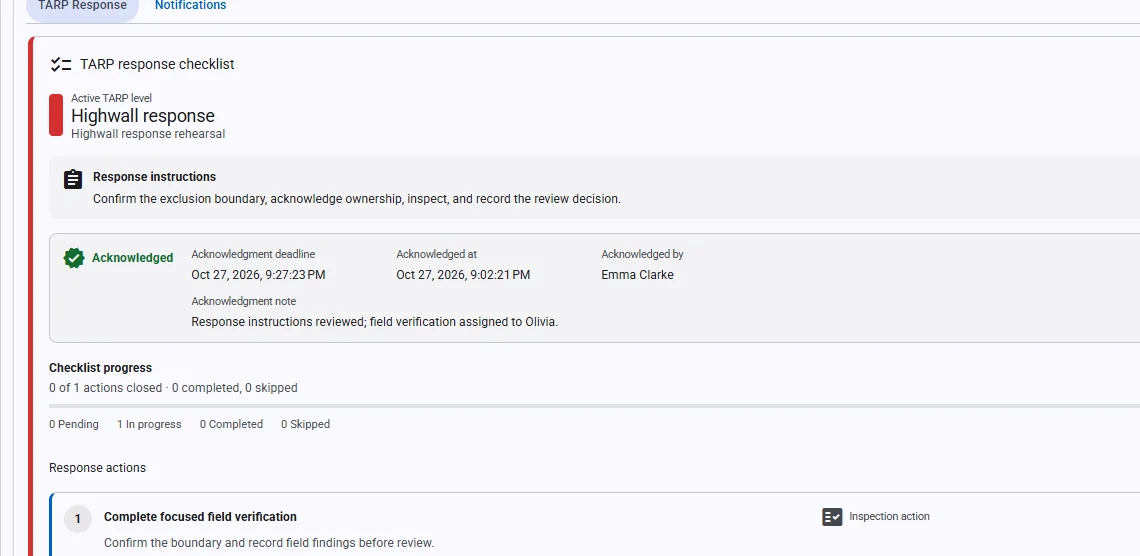
Trigger Action Response Plans become assigned actions with owners, deadlines, and evidence.

Keeping the plan with the Signal shows what is required and what still needs attention.

Signal Core TARP response checklist showing an active response level, its instructions, the acknowledgement record and the first response action
Required actions stay connected to the alert that activated them.

03 · Inspect in the field

Keep field work connected to the event.

Inspections requested by the response stay linked to the Signal, with their findings, photos, and follow-up.

Field teams can capture findings offline and synchronize them later.

01

Requested by the response

The inspection records why it was needed.

02

Findings and photos

Field evidence lands in the same case.

03

Follow-up

Further work stays visible until it is closed.

04 · Investigate

When the cause isn’t obvious, investigate it together.

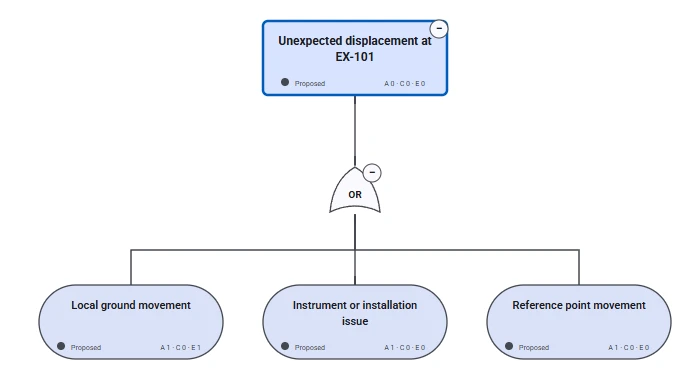
Use collaborative Fault Tree Analysis to explore possible causes, assess them against linked evidence, and preserve the conclusions that informed the response.

Keep the reasoning in context. Evidence and conclusions remain connected to the Signal for later review.

Signal Core fault tree with one observed problem and three candidate causes joined by an OR gate
Candidate causes, assessed against evidence.

05 · Decide & resolve

Record the decision, and why it was made.

The decision and its rationale are recorded with the case. If circumstances change, the Signal can be reopened without losing its history.

The complete case can become a reviewable report for operational and governance conversations.

01

Complete case history

Meaningful events remain in chronological context.

02

Evidence and response

Actions, field work, investigation, and decisions stay connected.

03

Reviewable output

A case summary and evidence package for review.

Connecting

Connects by API. Nothing to replace.

Your existing monitoring platform sends the alert to Signal Core by API, or a team member raises it manually. Sensors, data collection, and monitoring stay exactly as they are. Signal Core is not a data-integration project.

Fit with your systems is reviewed during discovery.

Alert from your monitoring platformAlert raised manuallyOne Signal Core operational caseTARP responseField inspectionsInvestigationDecision & Timeline

Around the case

Context that helps teams respond.

Signal Core supports the response around the Signal without replacing the specialist systems your teams already rely on.

1

Operational overview & work queue

See priority Signals, overdue work, and the TARP actions and inspections assigned to you in one place.

2

Spatial & engineering context

Connect each Signal to the relevant locations, assets, and monitoring points so teams can see where exposure exists.

3

AI InsightsOptional

Case briefs and answers that cite the case’s own records. Advisory only; people review and decide.

Multi-project governance

Manage multiple sites without losing operational boundaries.

Signal Core keeps operational records within the appropriate project context. Optional governance features add approvals and critical controls. Access and governance requirements are reviewed during discovery.

Deployment flexibility

Fit the operational environment.

Deployment options depend on operational, connectivity, security, and data requirements.

Deployment fit is reviewed during technical discovery before a trial or implementation is agreed.

Private demo

See one alert handled end to end.

Start with a short conversation and a private demo. Early trials and partnerships are discussed afterwards and agreed together.

Request a private demo